


There are few dishes that capture the soul of Louisiana quite like Jambalaya. Just thinking about it conjures images of spicy, hearty comfort, a symphony of savory notes, tender rice, and succulent proteins all mingling in one magnificent pot. As a chef, I’ve always been drawn to the rich history and soul-satisfying qualities of this beloved classic. If you’re looking to master Jambalaya, you’ve come to the right place. I’m here to guide you through creating a truly delicious and authentic Jambalaya, sharing not just a clear, easy-to-follow recipe, but also deeper insights into the key flavor components and techniques for perfect results, elevated by my unique enhancements.
Why You’ll Love This Recipe
In my kitchen, creating exceptional flavor is always the goal, and this **Jambalaya** recipe is a testament to that philosophy. While classic recipes are wonderful, I’ve honed a few techniques that truly elevate this dish from great to unforgettable.
* Deeply Browned Andouille First: My secret starts with the andouille sausage. By browning it deeply at the very beginning, we create a rich, caramelized fond at the bottom of the pot. This isn’t just about color; it’s about building a foundational layer of **umami** and smoky flavor through the Maillard reaction, while also rendering out its flavorful fat. This fat becomes the canvas for everything else.
* True Cajun ‘Holy Trinity’ with Celery: After rendering that beautiful sausage fat, we introduce the authentic Cajun ‘Holy Trinity’: **yellow onion**, **bell peppers**, and crucially, **celery**. Sautéing these aromatics in the rendered fat deglazes the pan, lifting all those precious browned bits and infusing the base with an incredible aromatic depth that’s essential for a truly complex **Cajun cuisine** profile.
* Authentic Cajun Seasoning (vs. Old Bay): While some recipes might call for Old Bay, for a genuine **Louisiana Jambalaya** flavor, I strongly advocate for a high-quality Cajun seasoning blend. This ensures you get the characteristic earthy, spicy, and herbaceous notes that define this dish, moving away from the mid-Atlantic profile of Old Bay towards true **New Orleans** authenticity.
* Shrimp Shell Stock for Ultimate Seafood Depth: For an unparalleled seafood richness, I suggest making a quick shrimp shell stock from your peeled shrimp shells. This simple step intensifies the natural seafood flavor and adds a robust, authentic **umami** to the entire dish, making your **shrimp Jambalaya** significantly more profound.
These straightforward techniques ensure you’ll achieve truly authentic Louisiana flavors at home, perfectly cooked rice every time, and a hearty and satisfying meal for family and friends, all from simple steps for complex flavors.
Ingredients Needed
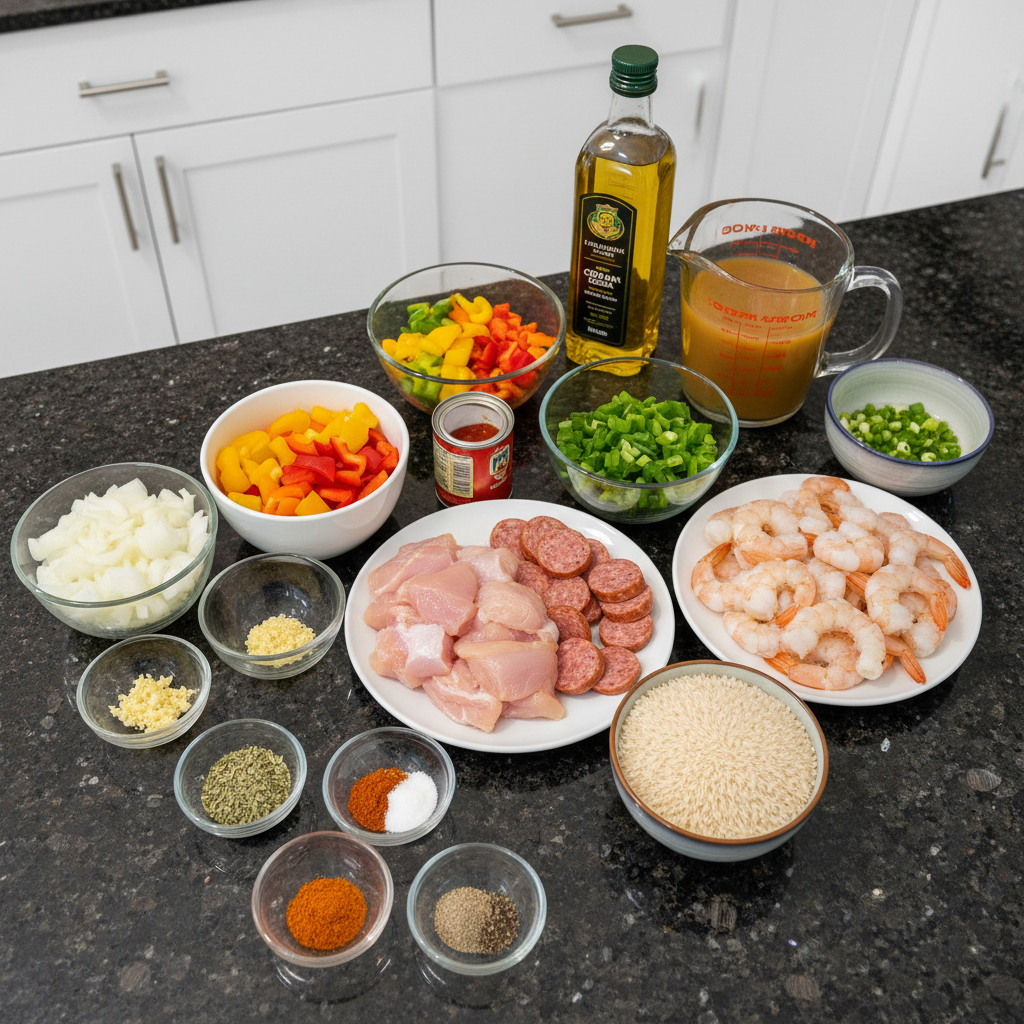
Here’s exactly what you’ll need to create this fantastic **Jambalaya**:
- 1 tbsp. extra-virgin olive oil
- 1 yellow onion, chopped
- 2 bell peppers, seeds and ribs removed, chopped
- Kosher salt
- Freshly ground black pepper
- 1 lb. boneless, skinless chicken breasts, cut into 1″ pieces
- 1 tsp. dried oregano
- 6 oz. andouille sausage, sliced
- 2 tbsp. tomato paste
- 2 cloves garlic, finely chopped
- 2 c. low-sodium chicken stock
- 1 (15-oz.) can crushed tomatoes
- 1 c. long-grain rice
- 2 tsp. Old Bay seasoning
- 1 lb. medium shrimp, peeled, deveined
- 2 scallions, thinly sliced
Ingredient Notes & Substitutions
* Cajun Seasoning: While the base recipe lists Old Bay, for truly authentic Cajun flavor, I strongly recommend substituting it with a high-quality store-bought Cajun seasoning blend like Tony Chachere’s or Slap Ya Mama. You can also whip up a simple homemade mix with **paprika**, **cayenne pepper**, **dried oregano**, **dried thyme**, **garlic powder**, **onion powder**, **black pepper**, and **Kosher salt**. This swap is crucial for that characteristic earthy, **spicy** profile.
* The Holy Trinity (and Celery): Our recipe uses **yellow onion** and **bell peppers**, but for an even deeper, more authentic **Cajun cuisine** aromatic base, I highly recommend adding 1 stalk of finely diced **celery** alongside them. This completes the traditional “Holy Trinity” and adds essential depth.
* Andouille Sausage: Using genuine **andouille sausage** is key for its signature smoky, **spicy** flavor. If it’s hard to find, you can substitute with other spicy smoked sausages or even **ground pork** with a generous pinch of smoked paprika and cayenne.
* Chicken: Boneless, skinless **chicken thighs** can be substituted for breasts. Just note that they might require a slightly longer cook time to ensure they’re tender.
* Rice: **Long-grain white rice** is ideal for **Jambalaya** as it cooks up separate and tender. For a less sticky texture, you can use parboiled rice. Brown rice is less traditional but can be used with adjustments to liquid and cooking time (typically more liquid and longer cook time).
* Chicken Stock: Always opt for **low-sodium chicken stock** to maintain control over the overall saltiness of your dish. For an incredible boost of **umami** and seafood flavor, consider making a quick shrimp shell stock from your peeled shrimp shells, then straining it and using it in place of some plain stock.
* Tomatoes: **Tomato paste** provides depth and richness, while **crushed tomatoes** add body and a subtle **sweet** acidity. For an extra kick, low-sodium Rotel (diced tomatoes with green chilies) can substitute the crushed tomatoes.
* Heat Level: If you love your **Jambalaya** extra **spicy**, don’t hesitate to add more **cayenne pepper** or even a thinly sliced **jalapeño** along with the Holy Trinity.
* Other Proteins/Veggies: Feel free to customize! **Crawfish**, **okra**, or even diced **carrots** are delicious additions that enhance both flavor and texture.
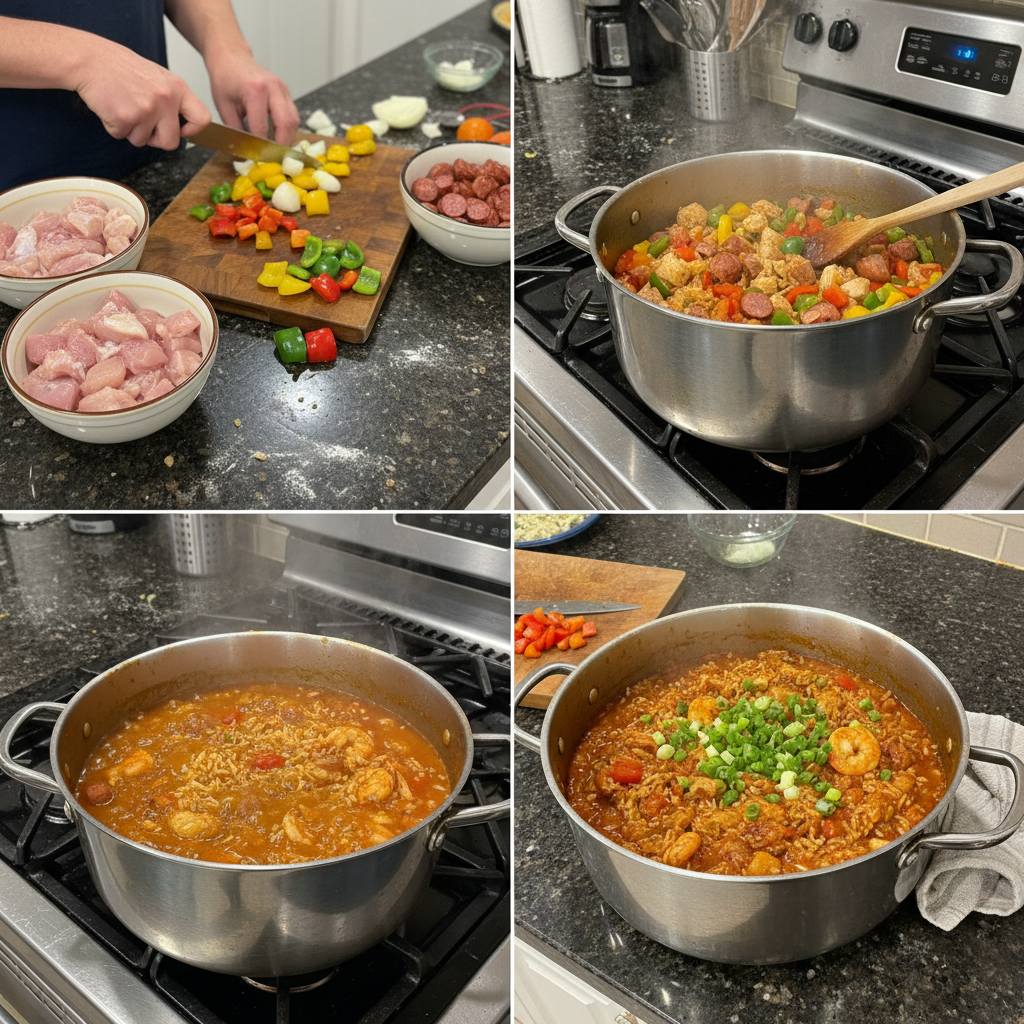
How to Make Jambalaya
Creating a truly flavorful **Jambalaya** is all about building layers. Follow these steps, and you’ll be enjoying a hearty, **flavor-packed** meal in no time.
Phase 1: Building the Flavor Foundation
- In a large pot or Dutch oven over medium heat, heat the **extra-virgin olive oil**. Add the chopped **yellow onion** and **bell peppers** (and celery, if using); season generously with **Kosher salt** and **freshly ground black pepper**. Cook, stirring occasionally, until the vegetables are beautifully softened and fragrant, about 7 minutes. This gentle **sautéing** is key to a sweet base.
- Stir in the 1-inch pieces of **boneless, skinless chicken breasts** and the 1 tsp. **dried oregano**; season again with **salt** and **pepper**. Continue to cook, stirring occasionally, until the **chicken** is golden brown on all sides, about 5 minutes. The golden crust adds another layer of flavor.
- Add the sliced **andouille sausage**, **tomato paste**, and finely chopped **garlic**. Cook, stirring frequently, for about 1 minute, until the garlic is wonderfully fragrant and the tomato paste has deepened in color. Ensure the **andouille sausage** gets nicely browned, releasing its flavorful fat and contributing to the fond on the bottom of the pot.
Phase 2: Simmering the Jambalaya Base
- Pour in the 2 cups of **low-sodium chicken stock** and the 1 (15-oz.) can of **crushed tomatoes**. Add the 1 cup of **long-grain rice** and the 2 tsp. of Old Bay seasoning (or, as recommended, your preferred authentic Cajun seasoning blend). Stir everything well to combine, ensuring you scrape up any delicious browned bits from the bottom of the pot.
- Reduce the heat to medium-low, cover the pot with a tight-fitting lid, and allow it to gently simmer. Resist the urge to lift the lid! This is crucial for creating the steam needed to cook the rice evenly. Cook until the **rice is tender** and most of the liquid is almost absorbed, about 20 minutes.
Phase 3: Finishing and Serving
- Finally, add the 1 lb. of peeled, deveined **medium shrimp**. Cook, gently tossing to combine, until the **shrimp** turn perfectly pink and are just cooked through, typically 3 to 5 minutes. Be careful not to overcook them, as they can become tough.
- Divide the finished **Jambalaya** among bowls, letting the aromas fill your kitchen. Top generously with thinly sliced **scallions** for a fresh, vibrant finish.
Cajun vs. Creole Jambalaya: Unpacking the Flavor Differences
When we talk about **Jambalaya**, it’s impossible not to delve into the fascinating distinction between Cajun and Creole styles. While both are quintessential Louisiana dishes, they represent different culinary traditions and geographical influences, leading to distinct flavor profiles.
**Creole Jambalaya** originated in the more urban, cosmopolitan city of **New Orleans**, particularly influenced by French, Spanish, and African cuisines. It’s often referred to as “red Jambalaya” because it typically includes **tomatoes** (like our recipe, which uses **tomato paste** and **crushed tomatoes**). This addition gives it a reddish hue and a slightly sweeter, more **acidic** flavor profile. Creole versions also tend to incorporate a wider variety of proteins, reflecting the city’s port access.
**Cajun Jambalaya**, on the other hand, hails from the rural, bayou country of southwest Louisiana, settled by French Acadian exiles. This style is often called “brown Jambalaya” because it traditionally omits **tomatoes**. Instead, its color and deep **savory** flavor come from extensively **browning** the meat (often pork or chicken) to create a rich **fond** at the bottom of the pot, before building the dish with the Holy Trinity (onion, bell pepper, and celery). It’s typically less sweet and more earthy, relying on the caramelized bits and rendered fats for its characteristic depth.
Both styles rely on the “Holy Trinity” (**yellow onion**, **bell peppers**, and **celery**, often with **garlic**), but in Creole cooking, garlic might be introduced earlier. Our recipe cleverly blends these influences: it’s a delicious, tomato-based (Creole-inspired) **Jambalaya**, but it incorporates strong Cajun flavor-building techniques like deeply **browning** the **andouille sausage** first, emphasizing the full Holy Trinity, and advocating for an authentic **Cajun seasoning** blend. This gives you the best of both worlds – a vibrant, **flavor-packed** dish with incredible depth.
Mastering Your Jambalaya Rice: Tips for Perfect Texture
Achieving perfectly cooked, fluffy rice in your **Jambalaya** can feel like an art, but with a few simple techniques, you’ll master it every time. Mushy or undercooked rice is a common pitfall, but I’m here to ensure your grains are always **tender rice** and separate.
**Choosing the Right Rice:** For **Jambalaya**, **long-grain white rice** is your best friend. Its lower starch content compared to medium or short-grain varieties means the grains are less likely to stick together, resulting in that desirable fluffy texture. Parboiled rice is another excellent option; it’s partially cooked before milling, making it even more forgiving and less prone to mushiness. I advise against medium or short-grain rice, as their higher starch content will make your **Jambalaya** gluey.
**The Golden Liquid-to-Rice Ratio:** Precision is paramount. Our recipe uses a 2 cups liquid to 1 cup rice ratio, which is ideal for **long-grain rice**. Sticking to this ratio is the foundation for perfectly cooked grains. Too much liquid leads to **mushy rice**, while too little results in crunchy, **undercooked rice**.
**The Importance of the Lid (and Patience!):** This is perhaps the most crucial tip. Once you add the rice and liquids, cover your pot with a **tight-fitting lid**. This traps the steam, which is essential for cooking the rice evenly and thoroughly. Resist the urge to lift the lid during the entire **simmering** process! Every time you peek, steam escapes, extending the cooking time and potentially leading to unevenly cooked rice.
**Resist Stirring:** Unlike a risotto, you absolutely do not want to stir your **Jambalaya** once the rice is added and the lid is on. Stirring releases starch, which makes the rice sticky and mushy. A gentle stir at the very end to incorporate the **shrimp** is all that’s needed.
**The Resting Period:** After the rice has cooked for the recommended time, turn off the heat but leave the pot covered. Let it rest for 5-10 minutes. This resting period allows the rice grains to finish absorbing any remaining moisture and steam, resulting in a fluffier, more distinct texture.
**Troubleshooting:**
* **Undercooked/Crunchy Rice:** If, after the resting period, your rice is still a bit hard, don’t despair. Add a small splash (about ¼ cup) of hot **chicken stock** or water to the pot, quickly re-cover with the **tight-fitting lid**, and cook on very low heat for another 5-10 minutes. Check again.
* **Mushy Rice:** This typically happens from too much liquid, over-stirring, or lifting the lid too often. Prevention is key! If it’s already a little mushy, you can try spreading it thinly on a baking sheet to dry out slightly, or simply embrace it as a hearty stew. For next time, ensure your measurements are precise and keep that lid on!
Pro Tips & Troubleshooting
To truly elevate your **Jambalaya** and avoid common pitfalls, here are my tried-and-true expert tips and a guide to troubleshooting.
Pro Tips
- Deep Flavor Foundation: As I emphasized, this is my golden rule. Start by browning your **andouille sausage** until it’s deeply caramelized and has rendered its precious fat. Then, **sautéing** the complete ‘Holy Trinity’ (**yellow onion**, **bell peppers**, and **celery**) in that richly flavored fat, scraping up all the savory **fond**, builds an unparalleled base that will infuse every bite of your **Jambalaya** with incredible depth.
- Homemade Cajun Seasoning: For the most authentic and vibrant flavor, skip the generic blends. Create your own simple, yet potent, **Cajun seasoning** mix. A fantastic blend includes 1 tbsp **paprika**, 1 tsp **cayenne pepper** (adjust to heat preference), 1 tsp **dried oregano**, 1 tsp **dried thyme**, 1 tsp **garlic powder**, 1 tsp **onion powder**, ½ tsp **black pepper**, and ½ tsp **Kosher salt**. Or, choose reputable brands like Tony Chachere’s.
- Shrimp Shell Stock: This step takes your **seafood Jambalaya** to another level! After peeling your **shrimp**, simmer the shells in about 1 cup of water or **chicken stock** for 15-20 minutes. Strain this flavorful broth and use it in place of some of the plain stock in your recipe. It adds amazing **umami** and natural seafood depth.
- Perfect Rice Texture: For a more distinct, non-sticky grain texture, lightly toast your **long-grain rice** in the rendered sausage fat or a little **vegetable oil** for a minute or two before adding the liquids. This creates a protective barrier around the grains.
- Control Saltiness: Always use **low-sodium chicken stock** and season gradually. Taste your **Jambalaya** before adding more **Kosher salt**, especially if you’re using a store-bought **Cajun seasoning** blend, which can be quite salty.
- Don’t Overcook Shrimp: **Shrimp** cook quickly! Add them only in the last 3-5 minutes of cooking, just until they turn pink and opaque. This ensures they remain succulent and tender, preventing that common tough, rubbery texture.
- Garlic Adjustment: Feel free to adjust the amount of **garlic** to your liking. For a true garlic fanatic, an extra clove or two will only enhance the **aromatic** depth!
Common Mistakes to Avoid
- Using Incorrect Seasoning: If aiming for authentic **Cajun cuisine** or Creole **Jambalaya** flavor, avoid using Old Bay. Its profile is distinctly different from traditional Louisiana blends.
- Skipping the Browning: Not thoroughly browning the **andouille sausage** (or the Holy Trinity vegetables) is a missed opportunity for crucial rendered fat and the development of rich, flavorful **fond** – the backbone of this dish’s depth.
- Undercooked or Mushy Rice: This often stems from incorrect liquid-to-rice ratios, insufficient cooking time, or, most commonly, constantly lifting the **tight-fitting lid** or **stirring** the rice while it cooks.
- Overcooking Shrimp: Adding **shrimp** too early or cooking them too long results in tough, rubbery **succulent seafood**. They only need a few minutes at the very end.
- Adding Too Much Liquid: Sticking to the recommended liquid ratios is vital. Excess liquid will lead to **mushy rice** and a soupy **Jambalaya**, rather than a hearty, satisfying dish.
Serving & Storage
A perfectly crafted **Jambalaya** is a meal in itself, but a few thoughtful additions can truly complete the experience.
Serving Ideas
- Garnishes: Top your steaming bowls of **Jambalaya** with a sprinkle of thinly sliced **scallions** (as per the recipe), fresh chopped parsley, or a dash of your favorite Louisiana hot sauce like Tabasco or Crystal for an extra **spicy** kick.
- Side Dishes: To complement the richness and spice, offer simple, cooling sides. A crisp green salad with a bright vinaigrette, a side of crusty French bread perfect for soaking up the delicious juices, sweet steamed corn on the cob, or Southern-style collard greens are all excellent choices.
- Beverage Pairings: For drinks, consider a crisp lager or an IPA to stand up to the spice, classic sweet iced tea, or a dry rosé wine which offers a lovely counterpoint to the **savory** flavors.
- Variations: Feel free to customize! Stir in sliced **jalapeño** for more heat, add **crawfish** for an extra seafood dimension, or include **okra** and **carrots** for more vegetables and texture.
Storage and Make-Ahead
- Refrigeration: Leftover **Jambalaya** stores beautifully. Transfer it to an airtight container and refrigerate for up to 3-4 days. The flavors often deepen overnight, making it even better the next day!
- Freezing: **Jambalaya** freezes exceptionally well, especially if made without **shrimp** (for optimal texture). Store in airtight, freezer-safe containers for up to 3 months. Thaw overnight in the refrigerator before reheating.
- Reheating: Gently reheat on the stovetop over low heat, adding a splash of **chicken stock** or water if it seems dry to prevent sticking and maintain moisture. Avoid high heat or prolonged reheating, particularly if **shrimp** are included, to prevent them from becoming mushy or tough. You can also microwave in short bursts, stirring often, until heated through.
- Meal Prep: Thanks to its excellent storage qualities and flavor development, **Jambalaya** is an ideal dish for **meal prep**. Cook a large batch on the weekend, and enjoy flavorful, hearty meals throughout the week.
FAQ
What is the ‘Holy Trinity’ in Jambalaya, and why is it essential?
The ‘Holy Trinity’ is the aromatic base of traditional Cajun and Creole cooking. It consists of finely diced **yellow onion**, **bell peppers**, and **celery**. It’s absolutely essential because when sautéed, especially in rendered fat like from **andouille sausage**, it builds the fundamental depth and flavor foundation for the entire dish.
Cajun vs. Creole Jambalaya: What are the key differences?
The main difference lies in the use of **tomatoes**. Creole **Jambalaya** (from **New Orleans**) typically includes **tomatoes**, giving it a reddish color and slightly sweeter profile. Cajun **Jambalaya** (from rural Louisiana) often omits **tomatoes**, relying on browned meat and **fond** for a darker, more **savory** flavor. Our recipe blends these by using tomatoes but emphasizing Cajun flavor-building techniques.
How do I get perfectly cooked rice in my Jambalaya every time?
To achieve **tender rice** consistently, use the correct 2 cups liquid to 1 cup rice ratio, ensure a **tight-fitting lid** is on the pot, avoid lifting the lid during the cooking process to trap steam, and resist stirring the rice. A short resting period off the heat after cooking also helps.
What is the best seasoning for authentic Jambalaya flavor? Is Old Bay seasoning authentic?
For authentic **Jambalaya** flavor, a dedicated **Cajun seasoning** blend (either store-bought like Tony Chachere’s or a homemade mix of **paprika**, **cayenne pepper**, **oregano**, **thyme**, **garlic powder**, **onion powder**, **black pepper**, and **Kosher salt**) is best. Old Bay seasoning, while delicious, is not traditional for **Jambalaya** and won’t provide the characteristic **spicy**, earthy profile of Louisiana cuisine.
Can I make Jambalaya spicier, and what are the best ways to do it?
Absolutely! To make your **Jambalaya** spicier, you can add more **cayenne pepper** to the seasoning blend, include sliced fresh **jalapeño** with the Holy Trinity, opt for an extra **spicy** **andouille sausage**, or simply serve it with a generous dash of your favorite hot sauce.
What are the best methods for storing and reheating Jambalaya leftovers?
Store leftover **Jambalaya** in an airtight container in the refrigerator for 3-4 days. It also freezes well (ideally without **shrimp** for best texture) for up to 3 months. To reheat, gently warm on the stovetop over low heat, adding a splash of **chicken stock** or water to prevent drying out, or microwave in short bursts, stirring frequently.
Should I brown the andouille sausage before adding other ingredients?
Yes, strongly! **Browning** the **andouille sausage** first is crucial. This step renders its fat, creating a flavorful base, and develops a rich **fond** at the bottom of the pot. This **fond** will be scraped up and incorporated into the dish, providing foundational depth and complex, **smoky** flavors.
How can I add more seafood flavor to my Jambalaya without adding more shrimp?
To infuse deeper **umami** and seafood flavor, make a quick shrimp shell stock. Simply simmer the peeled **shrimp** shells in about a cup of water or **chicken stock** for 15-20 minutes, then strain and use this flavorful broth in place of some of the plain stock in your recipe.
Can I add other vegetables like okra or carrots to Jambalaya?
Yes, these are common and delicious additions! Adding **okra** provides a unique texture and flavor, while diced **carrots** can add a touch of sweetness and extra nutrition. Feel free to incorporate them along with the Holy Trinity.
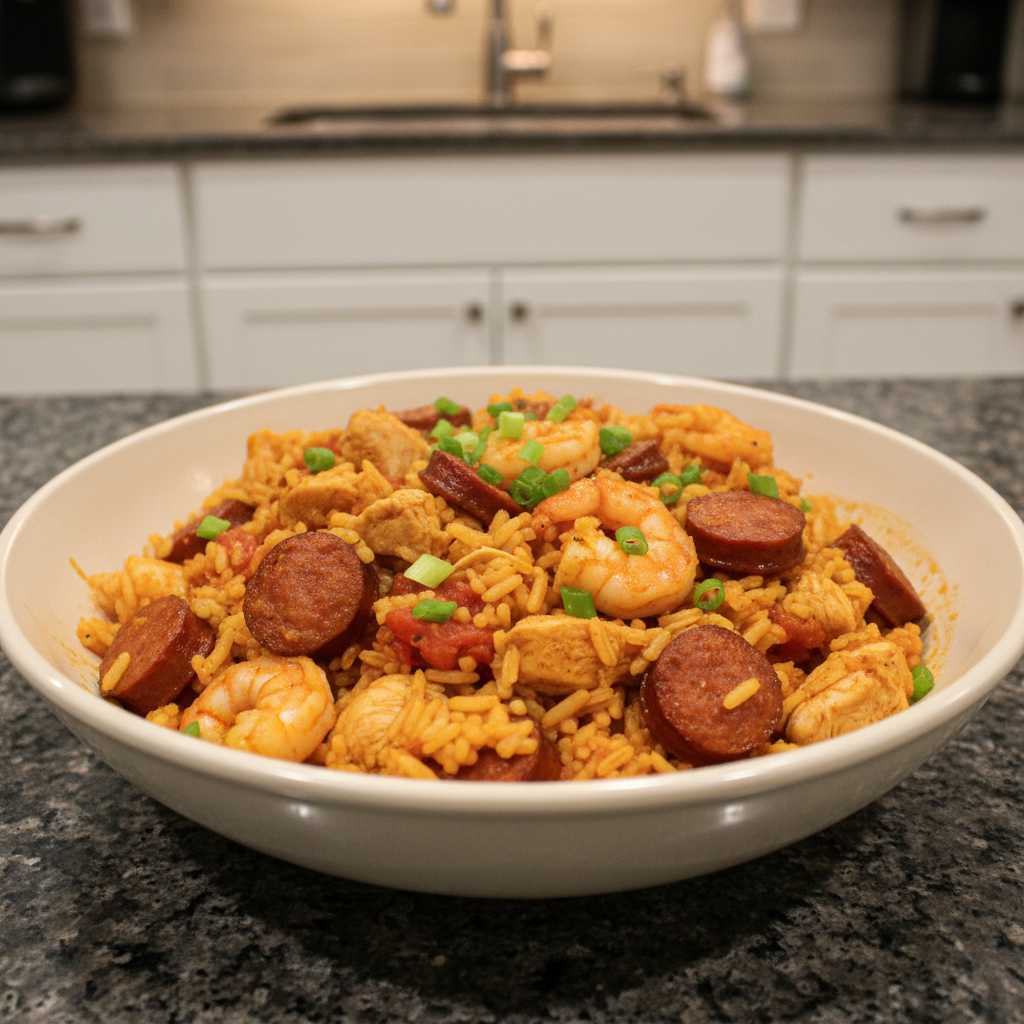
Authentic Louisiana Jambalaya
Ingredients
Equipment
Method
- In a large pot or Dutch oven over medium heat, heat the extra-virgin olive oil. Add the chopped yellow onion, bell peppers, and celery; season generously with Kosher salt and freshly ground black pepper. Cook, stirring occasionally, until the vegetables are beautifully softened and fragrant, about 7 minutes.
- Stir in the 1-inch pieces of boneless, skinless chicken breasts and the 1 tsp. dried oregano; season again with salt and pepper. Continue to cook, stirring occasionally, until the chicken is golden brown on all sides, about 5 minutes.
- Add the sliced andouille sausage, tomato paste, and finely chopped garlic. Cook, stirring frequently, for about 1 minute, until the garlic is wonderfully fragrant and the tomato paste has deepened in color. Ensure the andouille sausage gets nicely browned, releasing its flavorful fat and contributing to the fond on the bottom of the pot.
- Pour in the 2 cups of low-sodium chicken stock and the 1 (15-oz.) can of crushed tomatoes. Add the 1 cup of long-grain rice and the 2 tsp. of Old Bay seasoning (or your preferred authentic Cajun seasoning blend). Stir everything well to combine, ensuring you scrape up any delicious browned bits from the bottom of the pot.
- Reduce the heat to medium-low, cover the pot with a tight-fitting lid, and allow it to gently simmer. Resist the urge to lift the lid! This is crucial for creating the steam needed to cook the rice evenly. Cook until the rice is tender and most of the liquid is almost absorbed, about 20 minutes.
- Finally, add the 1 lb. of peeled, deveined medium shrimp. Cook, gently tossing to combine, until the shrimp turn perfectly pink and are just cooked through, typically 3 to 5 minutes. Be careful not to overcook them, as they can become tough.
- Divide the finished Jambalaya among bowls, letting the aromas fill your kitchen. Top generously with thinly sliced scallions for a fresh, vibrant finish.
