


There’s a special kind of magic that happens in my kitchen when I brew a batch of homemade fermented beverages. The gentle bubbling, the anticipation of natural fizziness, and the promise of gut-healthy goodness—it’s truly a rewarding experience. Among all the wonderful ferments, a good Water Kefir Recipe holds a special place for its refreshing taste and incredible simplicity. Whether you’re a seasoned fermenter or just starting your journey into the world of probiotics, this comprehensive guide is designed to make brewing your own water kefir at home not just easy, but exceptionally rewarding. Get ready to discover a unique twist that will elevate your brew to new heights!
Why You’ll Love This Recipe
What sets this Water Kefir Recipe apart and makes it truly special? My secret lies in a unique, subtle addition during the primary fermentation, one that results in a noticeably more robust, flavorful, and fizzy drink. You’re going to love it for several reasons:
- The Unique Fig-Infusion Twist: I infuse the primary fermentation (F1) with just 1-2 pieces of dried, unsulfured figs or apricots per quart/liter. These fruits are carefully removed with the water kefir grains before you move on to the secondary fermentation (F2). This subtle addition works wonders!
- Boosted Fermentation & Fizz: Dried fruits, especially figs, are natural powerhouses of essential minerals like calcium, magnesium, and potassium. These are vital nutrients that energize your water kefir grains, promoting more vigorous fermentation. The natural yeasts present on the fruit also give a little extra kick, contributing to truly enhanced carbonation in your final beverage. Using unsulfured fruit is crucial here, as sulfites can inhibit your precious culture.
- Superior Flavor & Fizz: The result is a subtle yet complex fruitiness infused into your base kefir, coupled with reliably fizzy and vibrant batches every time. It’s a taste profile you won’t get from sugar water alone.
- Healthier, More Robust Grains: By feeding your grains these vital minerals, you’re helping them thrive, grow, and remain active for countless batches. This leads to a more resilient and long-lasting culture.
- Easy Gut Health Boost: This naturally dairy-free, gluten-free, and vegan drink is packed with beneficial probiotics, offering a delicious and accessible way to support your gut health and overall microbiome.
- Refreshing Energy Alternative: Forget sugary sodas or artificial energy drinks. Your homemade water kefir is a naturally carbonated, low-sugar, and incredibly refreshing beverage that provides a natural pick-me-up.
Ingredients Needed
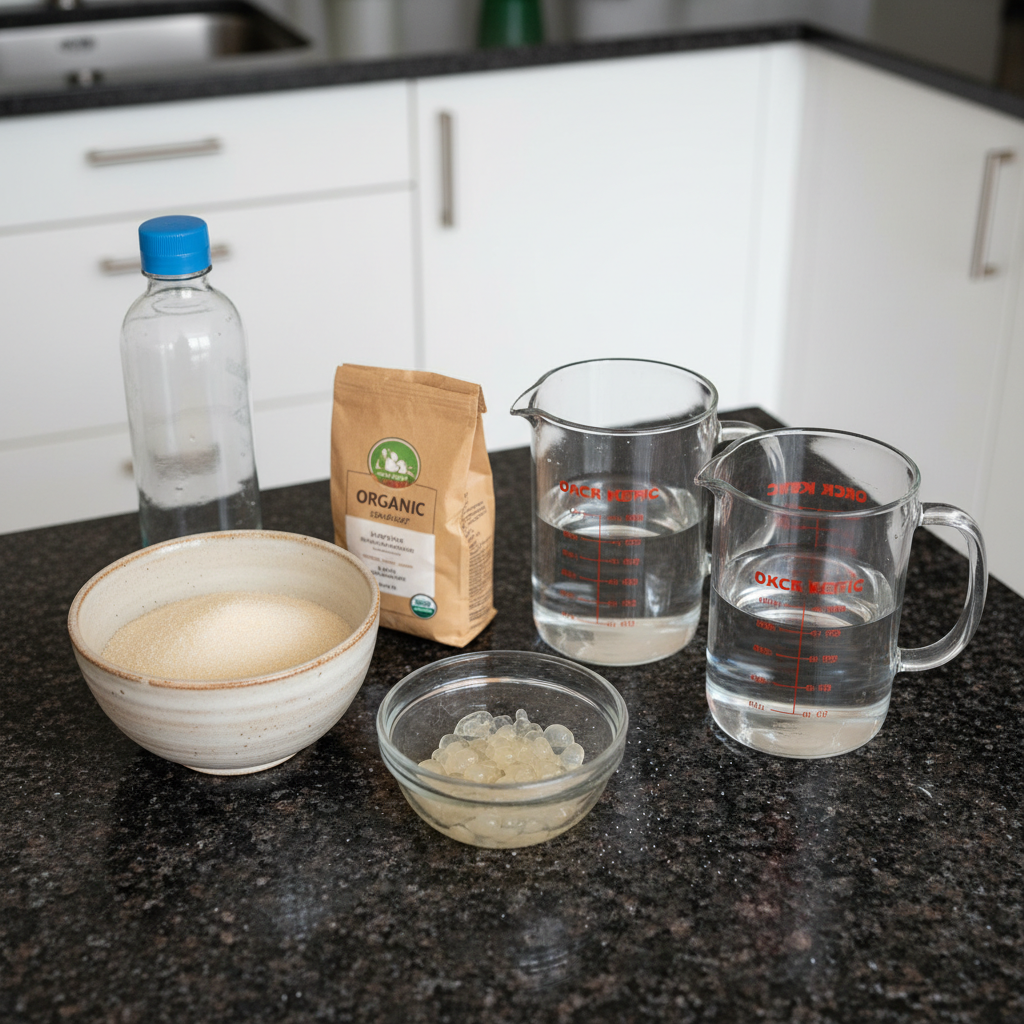
Gathering your ingredients is the first step towards brewing this fantastic Water Kefir Recipe. Make sure you have:
- 1 C / 250 ml Water
- ½ C / 100 g / 3.5 oz Sugar* (*Preferably a less-refined type such as organic blonde sugar. Do not use honey.)
- 4 T / 11 g / 0.4 oz Fresh water kefir grains** (**If the water kefir grains are dried, they need to be properly hydrated and activated before the first use.)
- 6½ C / 1.6 L / 56 oz Additional water, non-chlorinated
Ingredient Notes & Substitutions
Understanding your ingredients is key to successful fermentation.
Sugar: While water kefir grains can consume most types of sugar (Dextrose, Fructose, Sucrose), I highly recommend using less refined sugars like organic blonde sugar or turbinado sugar. These provide essential minerals that nourish your grains, leading to a more active and robust culture. It’s crucial to remember: do not use honey, as its antibacterial properties can harm your delicate water kefir grains.
Water: The quality of your water matters immensely. Always use non-chlorinated water. Chlorine and chloramines, commonly found in tap water, can inhibit or even kill your sensitive water kefir grains. Filtered, spring, or distilled water are all excellent choices. If you only have tap water, you can boil it and let it cool, or let it sit uncovered for 24 hours to allow chlorine to dissipate (though this isn’t effective for chloramines).
Water Kefir Grains: This recipe assumes you’re using fresh, active water kefir grains. If you’re starting with dehydrated grains, you’ll need to go through a process of rehydrating grains. This often takes 1-2 extra fermentation cycles to fully activate them and get them back to their optimal strength and activity.
The Unique Twist Ingredient (Dried Fruit): For this recipe’s special twist, select 1-2 pieces of dried, unsulfured figs or apricots per quart/liter of water kefir. The term “unsulfured” is important here; preservatives like sulfites can inhibit the beneficial bacteria and yeast in your culture, potentially preventing proper fermentation. Look for organic options or those explicitly labeled “unsulfured” at your local health food store.
Dietary Notes: One of the many benefits of water kefir is its natural compatibility with various diets. It is inherently gluten-free, dairy-free, and completely vegan, making it a fantastic probiotic source for almost everyone.
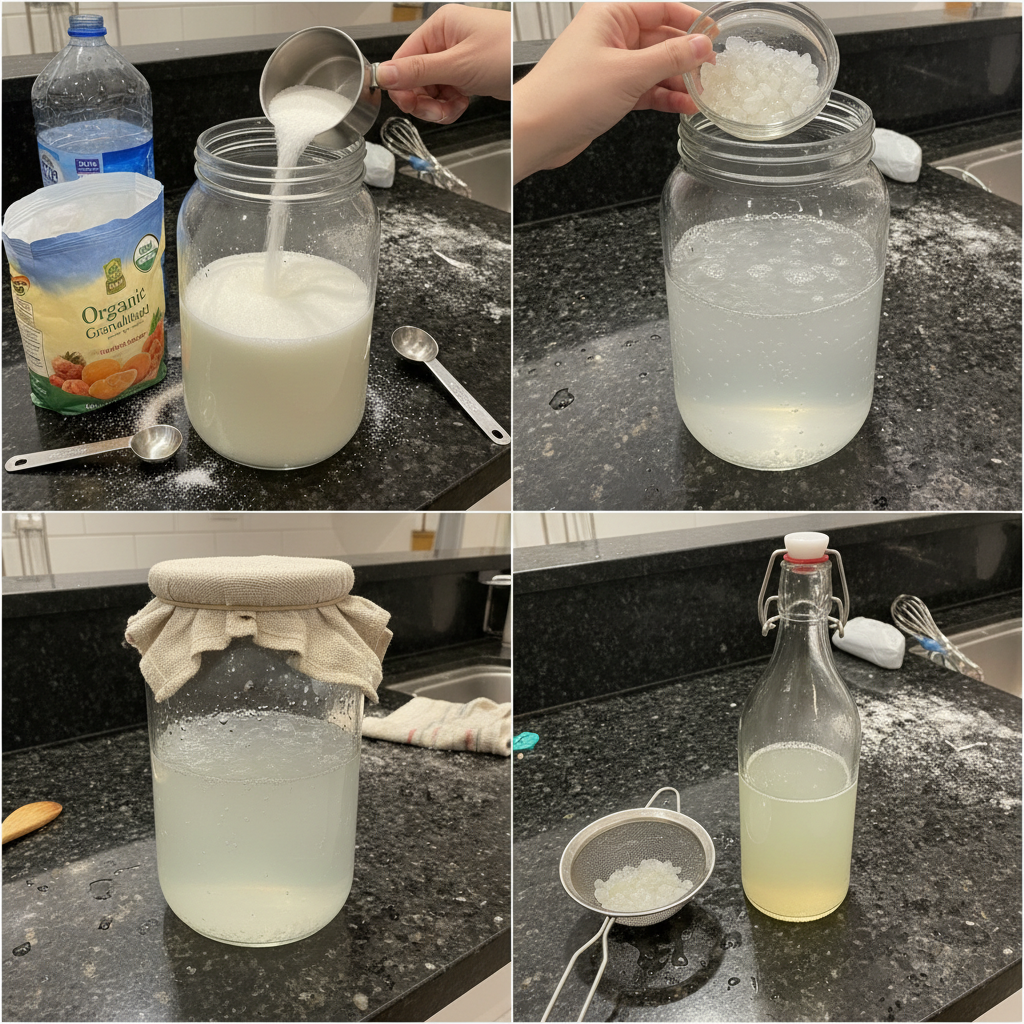
How to Make Water Kefir
Making your own water kefir is a straightforward process, especially when you follow these steps carefully. Let’s get brewing!
Phase 1: Preparation and Sugar Water Mixture
- Get Ready: Begin by setting up your Folding Proofer with the rack in place and the thermostat set to 75 °F / 24 °C. This ensures a consistent temperature control, which is vital for active fermentation. Make sure all your culinary tools—such as mason jars, swing-top bottles for later, funnels, and strainers—are sparkling clean and dry. I recommend thorough sanitization; for best results, consider using a wine brewing sanitizer like potassium metabisulfate, or simply run everything through a hot dishwasher cycle. Set out coffee filters or clean cloths and rubber bands to cover your jars.
- Make the Water Mixture: In a saucepan, combine all the sugar with 1 C / 250 ml of water. Heat gently, stirring constantly until the sugar completely dissolves, creating a clear syrup. This should happen around 150 °F / 65 °C. Remove the pan from the heat and allow it to cool for about ten minutes.
- Transfer the Warm Sugar Water: Carefully transfer the warm sugar water to your clean mason jars, dividing evenly if you’re using more than one. Add the additional non-chlorinated water to fill the jars, leaving a small space (about an inch) at the top to prevent spills during stirring and fermentation.
- Check the Temperature: This is a critical step! Before you introduce your culture, ensure the sugar-water mixture is below 85 °F / 29 °C. Adding grains to liquid that is too hot can damage or kill them. If necessary, allow the mixture to cool further.
Phase 2: First Fermentation (F1) – The Base Brew
- Add the Water Kefir Grains, Dried Fruit, and Cover: Once the sugar water is at the correct temperature, add the water kefir grains to each jar, using about 2 T / 5.5 g of grains for each quart / liter. Now, for our special twist: add 1-2 pieces of dried, unsulfured fig or apricot to each jar with the grains. Cover the jars with a breathable cover, such as a coffee filter or a clean cloth, secured tightly with a rubber band. While the culture doesn’t strictly require oxygen, a breathable cover prevents leaks and potential bottle explosions in the Proofer from pressure buildup, and also helps minimize the trace alcohol levels naturally produced by the culture.
- Ferment for 48 Hours: Place your jar(s) in the Folding Proofer to ferment. For the most accurate temperature control, arrange the jars so they are not directly over the center heating element. Allow the culture to ferment for two days (48 hours) at an ideal temperature of 75 °F / 24 °C. For a riper flavor or stronger natural carbonation, the temperature can be increased to 78 °F / 26 °C, or even up to 82 °F / 28 °C. Consistent warmth encourages active fermentation.
- When F1 is Done: After 48 hours, it’s time to check your water kefir. You’ll notice a few visible bubbles on the surface, indicating active fermentation. It should emit a pleasant, slightly yeasty smell, similar to bread dough. When you taste it, it should be mild and slightly sweet, with a hint of tang. The acidity will have increased, with the pH at about 4.3-4.5 at this point, but it won’t yet taste overly tart or vinegary.
Phase 3: Secondary Fermentation (F2) – Flavor and Fizz
- Create Naturally Carbonated Water Kefir: Before moving to bottling, it’s time to remove our primary fermentation additions. Fit a non-aluminum funnel and a fine-mesh strainer over your chosen F2 bottles. Before pouring in the fermented water kefir, give it a good stir with a spoon to evenly distribute the beneficial probiotics.
- Pour into Bottles: Carefully pour the fermented water kefir through the strainer into your swing-top bottles. As you pour, the water kefir grains (and the dried figs/apricots we added earlier!) will collect in the strainer. Make sure to leave a little airspace (about an inch) at the top of each bottle to allow for carbonation buildup. You can now use your healthy grains to start your next batch or store them according to the directions below.
- Seal & Ferment F2: Seal the bottles tightly with their swing-top caps. Allow them to ferment at cool room temperature for 2-3 days, ideally below 70 °F / 21 °C. After two days, check the carbonation of one of the bottles by gently opening it and tasting a little. If it’s noticeably fizzy, your bottles are ready to be chilled. If it isn’t yet fizzy enough for your liking, allow the bottles to ferment for another 12-24 hours. In warmer environments, you may need to shorten secondary fermentation to 1-2 days and consider “burping bottles” (briefly opening and re-sealing them) to release excess pressure and prevent potential bottle explosions.
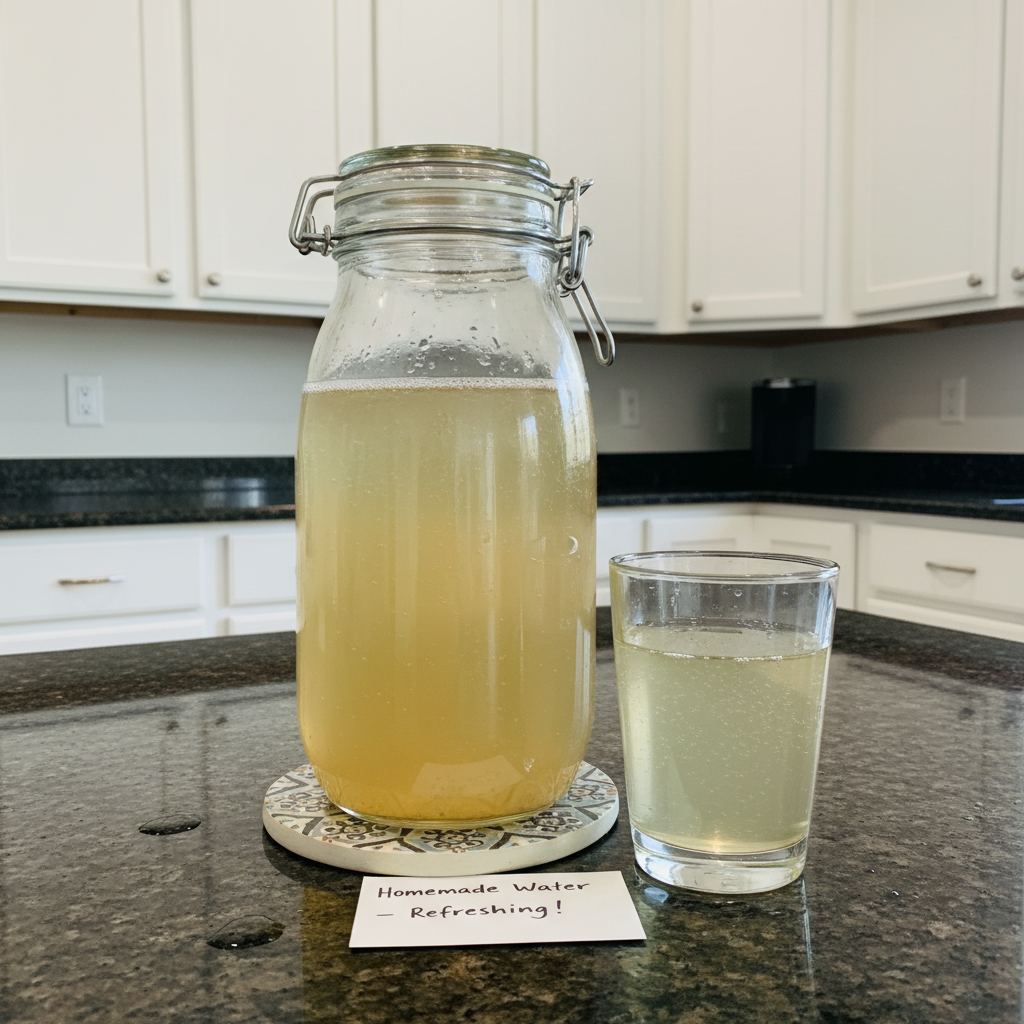
- Chill & Serve: Once the desired fizz is achieved, transfer your bottles to the refrigerator. Chilling your water kefir significantly slows down fermentation, locks in the carbonation, and dramatically improves the taste. Serve cold and enjoy!
Mastering Water Kefir Grains: Care, Storage, and Revival
Your water kefir grains are living organisms, a beautiful symbiotic culture of yeast and bacteria (SCOBY), and with proper care, they can thrive indefinitely. Knowing how to care for them is essential for continuous brewing and vibrant batches of water kefir.
Short-Term Storage (Refrigerator Storage)
If you need to take a break from brewing for a few days to a week, refrigerator storage is your best friend. Simply place your water kefir grains in a clean jar with a fresh solution of sugar water (use the same ratio as your regular brew, but you can scale down the quantity). Cover it with an airtight lid and store it in the refrigerator. The cold temperature significantly slows down their activity. I recommend changing their sugar water every 5-7 days to keep them happy and healthy. When you’re ready to brew again, simply strain the grains, give them a quick rinse with non-chlorinated water, and use them in a fresh batch.
Long-Term Storage (Freezer Storage, Dehydrated Grains)
For longer breaks, or if you want to create a backup, you have a couple of options for storing water kefir grains:
- Freezer Storage: This method can preserve grains for several months. Place healthy, active grains in a small amount of sugar water (just enough to cover them) in a freezer-safe container or freezer bag. They become dormant in the cold. When ready to use, thaw them slowly in the refrigerator, then proceed with the re-activation steps.
- Dehydrating Grains: This is excellent for very long-term storage (up to a year or more) or for sharing. Gently rinse your grains, pat them dry with a paper towel, then spread them in a single layer on parchment paper. Allow them to air-dry at room temperature in a well-ventilated area, away from direct sunlight, until they are hard and crystalline. This can take several days. Once completely dry, store them in an airtight container in a cool, dark place.
Re-activation Guide
Whether you’re reviving grains from the fridge, freezer, or after dehydrating grains, they will need some gentle encouragement to become fully active again. Place the grains in a fresh batch of sugar water (as per the main recipe). Your first few batches might be slow, and the taste may not be optimal. It’s completely normal for it to take 1-2 extra fermentation cycles for the grains to regain their full vigor, produce perfect flavor, and achieve optimal natural carbonation. Don’t be discouraged; simply continue feeding them fresh sugar water every 24-48 hours until they show consistent activity and a good taste.
When to Replace Your Grains
While water kefir grains are remarkably resilient and can last indefinitely, there are rare occasions when they might need to be replaced. Keep an eye out for these signs:
- Persistent Off-Taste: If your water kefir consistently has an unpleasant or “off-taste” (beyond just being too sour) despite proper care, temperature, and feeding, your grains might be compromised.
- Lack of Fermentation Activity: If your grains consistently fail to ferment, with no bubbles and no change in taste from sweet sugar water, even after several cycles and ensuring optimal conditions (temperature, non-chlorinated water, good sugar), they might have lost their vitality.
- Visible Mold: Any fuzzy, discolored patches (typically green, black, or pink) on your grains or the surface of your kefir indicates mold. Immediately discard the entire batch, including the grains, and thoroughly sanitize all your equipment. Better safe than sorry!
Pro Tips & Troubleshooting
Even with a great recipe, a few expert insights can make all the difference, and knowing how to troubleshoot common issues will save you headaches. Here are my top tips for this Water Kefir Recipe, plus some common pitfalls to avoid.
Pro Tips for Perfect Water Kefir
- Temperature is Key: For the most active culture and reliable natural carbonation, maintain your F1 fermentation temperature above 70 °F / 21 °C, ideally between 75-78 °F / 24-26 °C. Our Folding Proofer makes this incredibly easy!
- Feed Your Grains Well: Always opt for less refined sugars like organic blonde sugar or turbinado sugar. These provide the essential minerals your grains need to thrive, especially if you’re using filtered water that might be mineral-poor. The fig-infusion twist also significantly boosts these vital nutrients!
- Hydrate Dehydrated Grains: If you’re using dehydrated grains, remember they need 1-2 extra fermentation cycles to fully activate and get back to peak performance. Be patient!
- Breathable Covers: During F1, always use a breathable cover (like a coffee filter or cloth). This prevents messy bottle explosions from pressure buildup and also helps to minimize any natural trace alcohol levels that the culture produces.
- Optimal Proofer Placement: If using a Folding Proofer, arrange your jars so they are not directly over the center heating element. This ensures more even and accurate temperature control.
- Know When F1 is Done: Look for consistent cues: a few visible bubbles on the surface, a faint yeasty smell (like bread dough), and a taste that is pleasantly mild and slightly sweet, with a hint of tang (a pH of 4.3-4.5 is ideal).
- Choose Strong Bottles: For F2, invest in good quality strong swing-top bottles. These are designed to safely withstand the pressure buildup from carbonation.
- Even Probiotic Distribution: Before bottling for F2, give your primary fermented water kefir a good stir. This helps to evenly distribute the beneficial probiotics throughout your drink.
- Carbonation Check: After 2 days in F2, open and taste one bottle. If it’s not fizzy enough, reseal and allow it to ferment for another 12-24 hours. The fig-infusion twist should help achieve consistent fizz!
- Warm Weather Alert: In warmer environments, secondary fermentation can accelerate. Shorten F2 to 1-2 days and consider “burping bottles” daily to release excess pressure and prevent dangerous bottle explosions.
- Sanitization is Paramount: Thorough sanitization of all your culinary tools and bottles (e.g., using potassium metabisulfate or boiling water) prevents unwanted bacteria or mold from contaminating your delicious brew and causing an off-taste.
- Reinforce the Twist: Remember, the fig-infusion isn’t just for flavor; it actively contributes to more robust grains and better carbonation, making all these tips even more effective!
Common Mistakes to Avoid
- No Honey: I can’t stress this enough: do not use honey. Its natural antibacterial properties can damage or even kill your delicate water kefir grains.
- Too Hot Sugar Water: Never add your grains to sugar water that is hotter than 85 °F / 29 °C. This is a common mistake that can easily harm your culture.
- Airtight F1 Seal: An airtight seal during primary fermentation is a common mistake that can lead to messy leaks or dangerous explosions from pressure buildup. Always use a breathable cover for F1.
- Forgetting to Burp F2: Especially in warmer environments, failing to “burp bottles” during secondary fermentation can lead to excessive pressure buildup and potentially dangerous bottle explosions.
- Poor Hygiene: Neglecting proper sanitization of your equipment is a recipe for contamination, leading to an off-taste or even mold in your brew.
- Ignoring Grain Health: Don’t overlook the activity and health of your grains. If they seem sluggish or your kefir develops an off-taste, address it promptly to avoid failed batches.
Serving & Storage
You’ve successfully brewed your own water kefir! Now for the fun part: enjoying it and making sure it lasts.
Delicious Serving Ideas
Your finished water kefir is a wonderfully versatile base. Here are some of my favorite ways to enjoy it:
- Straight Up: My preferred way! Enjoy it simply chilled as a refreshing, tangy, and naturally carbonated probiotic-rich energy drink.
- Smoothie Base: Use it as a vibrant, healthy probiotic base for smoothies. It adds a delicious tang and an extra health kick to your morning blend.
- Frozen Treats: Blend your finished water kefir with fresh or frozen fruit (berries are fantastic!) and freeze the mixture in popsicle molds for a healthy, fizzy treat.
- Flavor Inspirations (F2): This is where you can truly get creative with secondary fermentation! After straining your grains, add these to your F2 bottles along with the kefir for a second round of flavor development:
- Sweet Fruit Juice: A splash of grape juice, cherry juice, apple juice, or orange juice works beautifully.
- Citrus Zing: A squeeze of fresh lemon juice, lime juice, or grapefruit juice adds brightness. You might want to add a tiny pinch of extra sugar to help with carbonation and balance the tartness.
- Ginger Kick: Add thin-sliced or minced fresh ginger for a spicy, invigorating flavor.
Storage and Make-Ahead Tips
Proper storage ensures your delicious homemade water kefir stays fresh and fizzy for longer.
Finished Water Kefir Storage: Once bottled and chilled after F2, homemade water kefir stays wonderfully fresh when refrigerated. For optimal fizz and flavor, I recommend consuming it within 1-2 weeks. It will generally remain good for up to 3-4 weeks, though the carbonation might diminish slightly over time. Non-carbonated kefir (straight after F1, before bottling) can also be refrigerated and consumed within a similar timeframe, though it won’t have the effervescence.
Signs of Spoilage: You’ll usually know if your water kefir has gone off. It will develop a distinct off-taste, often becoming excessively sour or vinegary, or you might notice unpleasant or funky odors. While rare, any visible mold means it’s time to discard the batch. Trust your senses!
Scaling the Recipe: This recipe can easily be scaled up or down. The key is to maintain the proportional sugar-to-water-to-grain ratios. For example, if you double the water and sugar, double the grains. Consistent ratios are crucial for balanced fermentation.
Grain Storage Reminder: For detailed guidance on how to store your actual water kefir grains for short or long breaks, please refer back to our dedicated Section 5: “Mastering Water Kefir Grains: Care, Storage, and Revival.”
Conclusion
Brewing your own water kefir is a deeply satisfying and surprisingly simple culinary adventure. This Water Kefir Recipe, with its unique fig-infused twist, not<<link_place_holder_1>> only delivers a delightfully flavorful and fizzy drink but also ensures your water kefir grains remain robust and healthy for years to come. The subtle fruitiness, reliable natural carbonation, and the pure joy of creating your own probiotic-rich beverage at home are unparalleled.
I encourage you to embrace this process—from the careful sanitization to the exciting moment of tasting your perfectly carbonated F2. With the tips and guidance I’ve shared, success is absolutely achievable for fermenters of all skill levels. Don’t stop here; feel free to experiment with different secondary fermentation flavors, share your beautiful creations with friends, and continue exploring the wonderful world of fermented foods. Happy brewing!
FAQ
Here are some frequently asked questions to further assist you on your water kefir journey:
Q: What is water kefir and what are its health benefits?
A: Water kefir is a light, naturally carbonated, and refreshingly tangy fermented drink made by culturing sugar water with water kefir grains. It’s a fantastic source of beneficial probiotics, supporting gut health, contributing to a diverse microbiome, aiding digestion, and boosting immune function. It’s also a great hydrating and natural energy drink alternative.
Q: How do water kefir grains work, and can they be reused and stored?
A: Water kefir grains are not actual grains but a symbiotic culture of yeast and bacteria (SCOBY), resembling small, translucent crystals. They consume sugar in water, producing lactic acid, carbon dioxide, and other beneficial compounds. Yes, they are highly reusable and, with proper care, can be kept active indefinitely. For details on short-term refrigerator storage and long-term methods like freezer storage or dehydrating grains, refer to Section 5.
Q: What’s the best temperature for fermenting water kefir and achieving carbonation?
A: Temperature control is crucial. For the First Fermentation (F1), an ideal range is 75-78 °F / 24-26 °C to ensure active fermentation. For Secondary Fermentation (F2) and achieving good natural carbonation, cooler room temperatures below 70 °F / 21 °C are best, as this allows the CO2 to dissolve into the liquid more effectively. Our fig-infusion during F1 also contributes to more vigorous fermentation, aiding in carbonation.
Q: How long can homemade water kefir be stored, and how do I know if it’s gone bad?
A: Homemade water kefir, once bottled and refrigerated, is best enjoyed within 1-2 weeks for optimal fizz and flavor, though it can remain palatable for 3-4 weeks. If it has gone bad, you’ll likely notice an excessively sour or vinegary off-taste, strong unpleasant or funky odors, or rarely, visible mold. When in doubt, it’s best to discard.
Q: What are the best types of sugar and water to use for water kefir?
A: I recommend using less refined sugars like organic blonde sugar or turbinado sugar because they contain trace minerals that nourish the water kefir grains. Always use non-chlorinated water (filtered, spring, or distilled) as chlorine can harm your delicate culture.
Q: How can I safely flavor and carbonate water kefir?
A: The Second Fermentation (F2) is where you add flavors. Simply strain your finished F1 water kefir (removing grains and the primary fermentation fruit), add your chosen flavoring (e.g., fruit juice, fresh fruit, ginger, citrus like lemon juice) to strong swing-top bottles, and seal them. To prevent dangerous bottle explosions, always use sturdy bottles and practice “burping bottles” in warm environments by briefly opening and re-sealing them to release excess pressure and prevent dangerous bottle explosions.
Q: Can I consume water kefir if I am allergic to dairy or am gluten-free/vegan?
A: Absolutely! Water kefir is naturally dairy-free, gluten-free, and vegan, making it a wonderful probiotic beverage suitable for a wide range of dietary needs.
Q: What is the typical alcohol content of homemade water kefir?
A: Homemade water kefir typically has a very low alcohol content range, usually less than 0.5-1% ABV. This is similar to many other fermented foods and drinks, like some sourdough breads or ripe fruit, and is generally considered negligible.
Q: Do I need to strain the grains for secondary fermentation?
A: Yes, it is essential to strain out the water kefir grains (and any primary fermentation fruit like the figs or apricots) before bottling for secondary fermentation. This prevents over-fermentation in the bottle, ensures a cleaner final product, and allows you to reuse your grains for your next batch.
Homemade Water Kefir Recipe: Fig-Infused for Extra Fizz & Benefits
Ingredients
Equipment
Method
- Begin by setting up your Folding Proofer with the rack in place and the thermostat set to 75 °F / 24 °C. Ensure all your culinary tools—such as mason jars, swing-top bottles for later, funnels, and strainers—are sparkling clean and dry. Consider sanitizing with potassium metabisulfate or running through a hot dishwasher cycle. Set out coffee filters or clean cloths and rubber bands to cover your jars.
- In a saucepan, combine all the sugar with 1 C / 250 ml of water. Heat gently, stirring constantly until the sugar completely dissolves, creating a clear syrup (around 150 °F / 65 °C). Remove the pan from the heat and allow it to cool for about ten minutes.
- Carefully transfer the warm sugar water to your clean mason jars, dividing evenly if using more than one. Add the additional non-chlorinated water to fill the jars, leaving about an inch of space at the top.
- Before introducing your culture, ensure the sugar-water mixture is below 85 °F / 29 °C. Allow the mixture to cool further if necessary, as liquid that is too hot can damage or kill the grains.
- Once the sugar water is at the correct temperature, add the water kefir grains to each jar (about 2 T / 5.5 g of grains per quart / liter). Add 1-2 pieces of dried, unsulfured fig or apricot to each jar with the grains. Cover the jars with a breathable cover, such as a coffee filter or a clean cloth, secured tightly with a rubber band.
- Place your jar(s) in the Folding Proofer, ensuring they are not directly over the center heating element, to ferment for two days (48 hours) at an ideal temperature of 75 °F / 24 °C. For a riper flavor or stronger natural carbonation, the temperature can be increased to 78 °F / 26 °C, or even up to 82 °F / 28 °C.
- After 48 hours, check your water kefir. You should notice visible bubbles, a pleasant, slightly yeasty smell, and a mild, slightly sweet taste with a hint of tang (pH at about 4.3-4.5).
- Before bottling, fit a non-aluminum funnel and a fine-mesh strainer over your chosen F2 bottles. Give the fermented water kefir a good stir with a spoon to evenly distribute the beneficial probiotics.
- Carefully pour the fermented water kefir through the strainer into your swing-top bottles. The water kefir grains and dried figs/apricots will collect in the strainer. Leave about an inch of airspace at the top of each bottle. You can now use your grains for the next batch or store them.
- Seal the bottles tightly with their swing-top caps. Allow them to ferment at cool room temperature for 2-3 days, ideally below 70 °F / 21 °C. After two days, check the carbonation by gently opening and tasting. If not fizzy enough, allow to ferment for another 12-24 hours. In warmer environments, consider “burping bottles” to release excess pressure.
- Once the desired fizz is achieved, transfer your bottles to the refrigerator. Chilling significantly slows down fermentation, locks in carbonation, and dramatically improves the taste. Serve cold and enjoy!
